National Folk Museum of Korea
Sacred Tiger
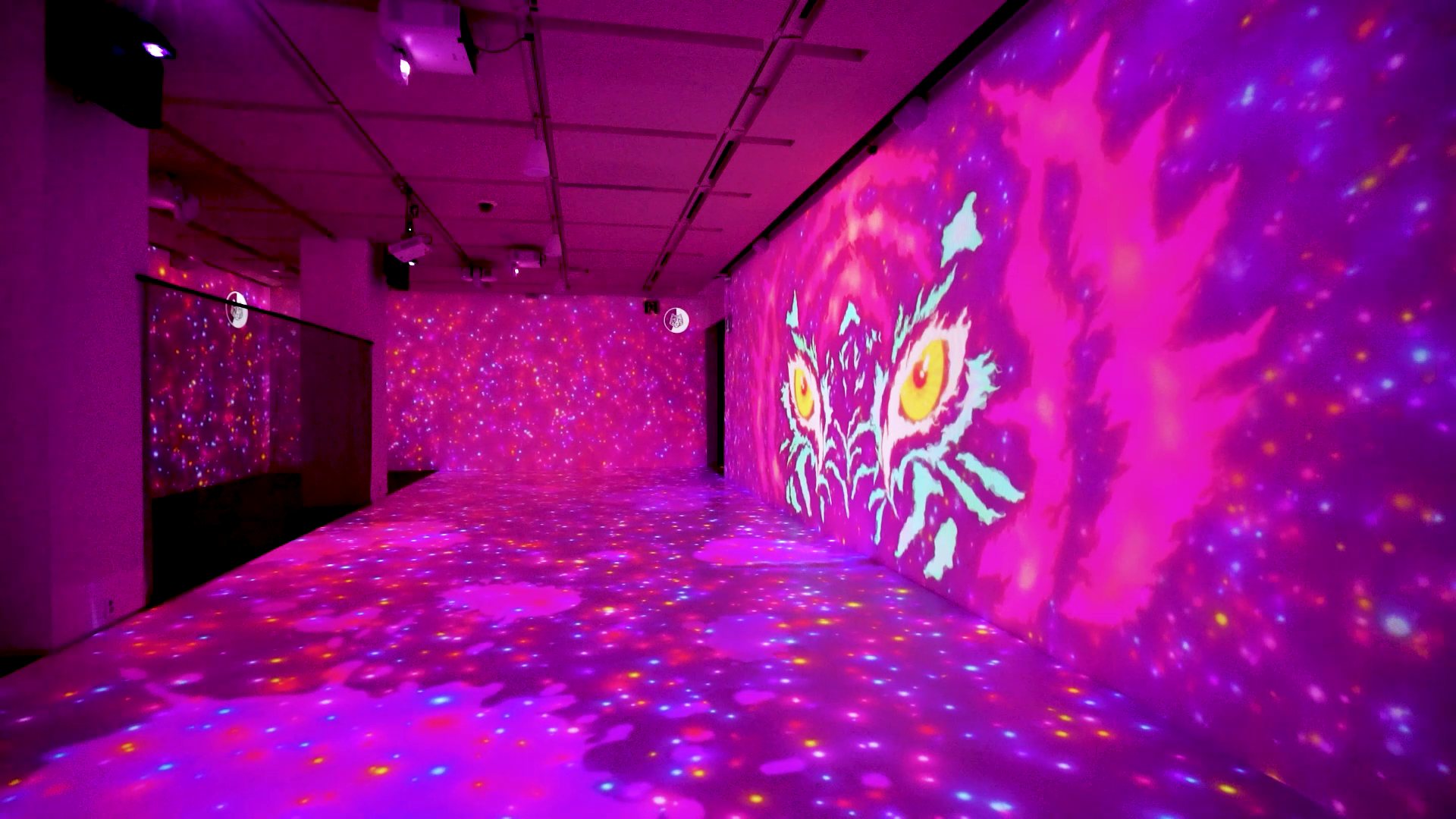
Recording of the installed room2:061920×1080
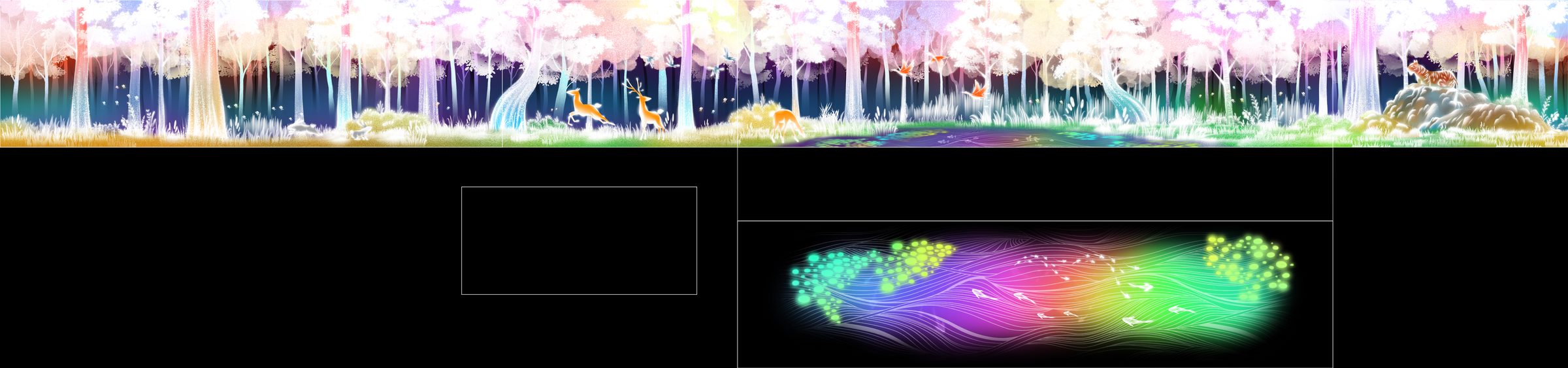
Joseon paintings were horizontally long to begin with — the tiger of Korean folk painting, moved onto a five-surface immersive screen.
The starting point was that much Joseon-era painting took the form of horizontally long scrolls. That fact made the link between an extremely wide immersive screen and folk painting a natural formal argument rather than a conceit. Early artwork established a very long background space, and elements were layered across it to build depth.
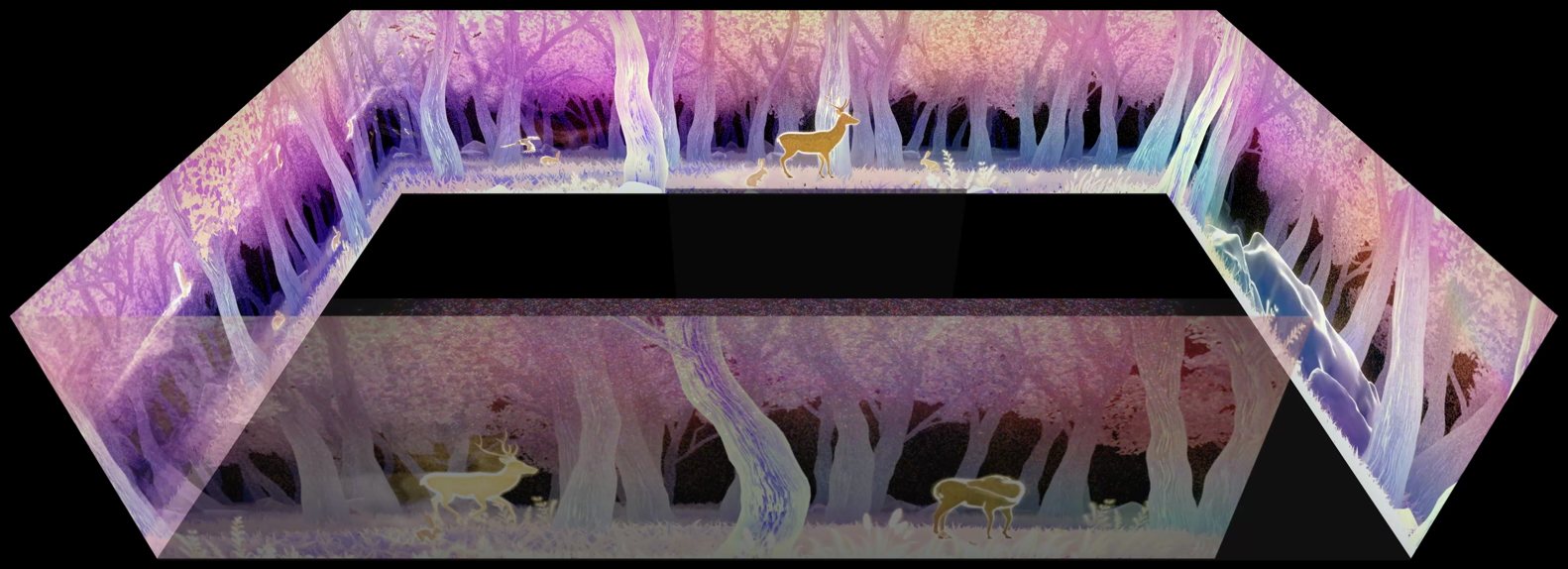
The problem was that folk painting is emphatically flat, while a five-surface immersive screen inevitably produces depth and movement. The work had to satisfy the flatness of the painting and the immersion of the medium at the same time.
The background and surrounding elements stayed as 2.5D layers to preserve that flatness, and the tiger alone was built in 3D. Referencing tigers in old folk paintings, a new character was designed and rigged so that it moves freely as the single dimensional object in a flat world. The form was not handed to generation for the same reason — lose the exaggerated proportions specific to minhwa and what is left is an ordinary animal picture.
“Connecting the long screen to folk painting was a natural process — Joseon paintings were horizontally long to begin with.”
A Tiger That Just Breathes
National Folk Museum of Korea · my first art direction · a production blog
“I really love it!”
That was the curator at the National Folk Museum, putting both hands together and reacting a little over the top when I introduced myself as the motion designer of the breathing tiger video.
My job was to bring a tiger folk painting to life. The illustrator, Junho Ko TBC, had reborn the traditional painting with a modern sense, and I was the one who had to make it move. For several days I watched footage of real tigers, trying to work out which motion is the most tiger-like.
The obvious answers are a thunderous roar or a threatening charge. But when I looked closely, what tigers do most is just breathe, with a low rumble, and now and then shake their heads. So I made a tiger sitting at ease, breathing. The curator agreed that was the most tiger-like motion.
That single-screen video, installed in a corner of the museum's planning office, was the start of the project. The museum was preparing an exhibition called 호랑이 신나다 TBC, and I was asked to art direct one piece of it, an immersive multi-wall film on the Korean tiger. It was the first art direction I took on at an exhibition company.
The brief came from the tiger's old reputation. In ancient Korea, the tiger was a godly creature: people believed it ruled nature, protected the world from evil, and brought peace to the village. The museum wanted all of that in the film, so it became three chapters: the ruler of the forest, the warrior fighting the evil ones, and the peacemaker of the village.

Chapter two is where we pushed back. In the original brief, the evil creatures were a herd of tiny particle-like things that would come together into one huge evil creature. We saw two problems. First, that kind of disintegration and reintegration effect has been used in so many films, so there was nothing new or exciting about it. Second, even if we decided to do it, it would have been very hard to do in 2D animation.
So my team came up with a different idea. We researched the Yogoe, the evil creatures of ancient Korean folk stories, picked several interesting kinds, and made a whole army of them marching across the wall. The scene became unique and powerful. To get the museum on board, we showed them pictures: a character design for every creature, and concept images for the scenes. They were satisfied.

Directing and communicating turned out to be easier than I had feared, because I was a designer and an animator myself. Rendering was the hard part. I had never rendered a video this large for a multi-wall, and I was still rendering right up to the last moment before the field preview. The crisis did one useful thing: it gave my team a reason to upgrade their computers, and we built tools and workarounds to render faster. TBC
The preview went well, and everybody was satisfied.
It's still one of my favourite things I've made. It started as a tiger breathing in the corner of a planning office, and it ended as an army marching across a wall. I like that it began quiet.
How it was made
- 1
Reference & Consultation
Organised minhwa tiger iconography alongside the horizontal scroll format of Joseon painting, establishing the formal argument linking a long screen to folk painting.
- 2
Look Development
Built a very long background space in early artwork and limited the palette to ink with folk-painting colour.
- 3
Setting the Rules
Fixed the background and surrounding elements as 2.5D layers, so depth could exist without breaking the flatness of the painting.
- 4
Generation & Compositing
Designed a new tiger in 3D from old folk-painting references and rigged it as the one object free to move across the flat background.
- 5
Grade & Master
Matched colour and brightness across the five surfaces and cleaned the loop so it connects wherever a visitor enters.
Credits
If you are planning something at this scale
Available for exhibition and museum film, media façades, and immersive projection.
hello@jmukpark.com ↗